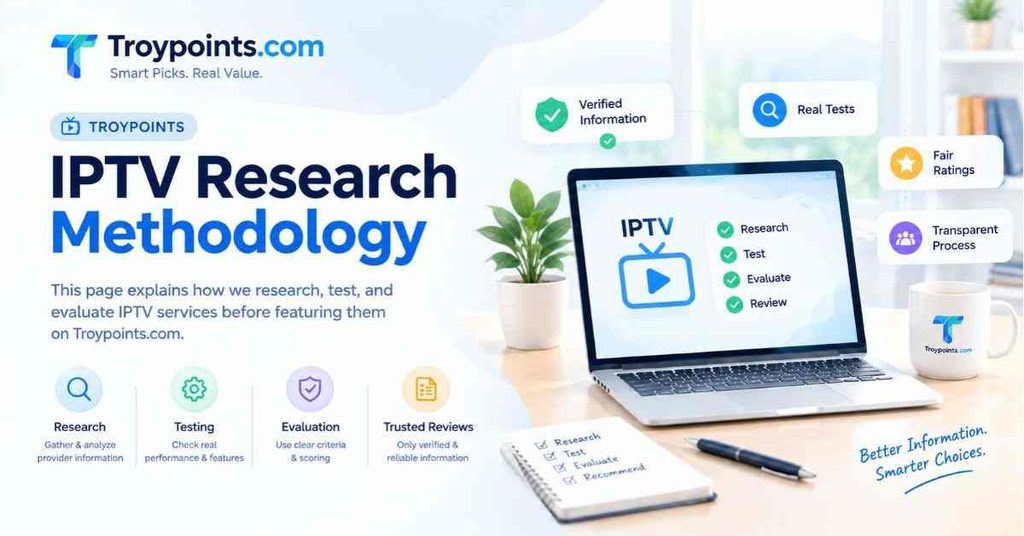
This page outlines how we research, test, and evaluate IPTV services before featuring them on Troypoints.
Our IPTV research methodology explains how we review providers, verify important claims, assess available evidence, and compare services. The goal is to help readers understand what a review is based on, what has been tested, and what remains unverified.
We aim to prioritize evidence over advertising claims, apply consistent evaluation criteria, and clearly communicate the limitations of our findings.
1. Our Research Principles
Every evaluation should follow four principles:
- Evidence first: Important claims should be supported by direct observations, reliable documentation, or clearly identified sources.
- Consistent criteria: Providers should be assessed using the same relevant standards wherever a fair comparison is possible.
- Transparent limitations: We disclose when information or testing is incomplete.
- Editorial independence: Commercial relationships, where applicable, should be disclosed and should not be presented as proof of service quality.
2. How Our Research Process Works
Step 1: Collect Provider Information
We review publicly available information, including official websites, subscription plans, device compatibility details, channel descriptions, terms of service, privacy policies, and customer support options.
We record relevant claims and look for missing, outdated, or inconsistent information.
Step 2: Verify Important Claims
We compare provider claims with available documentation and independent evidence where possible. For example, a provider’s advertised device support is not the same as confirmed compatibility, and a published channel list does not establish that every channel works reliably.
We distinguish between information stated by a provider and information independently verified by our research.
Step 3: Test Features Where Access Is Available
When we have appropriate access to a service, we may assess installation, channel loading, playback stability, navigation, Electronic Program Guide (EPG) functionality, and supported device compatibility.
We identify the test conditions and scope wherever practical. Features that have not been tested are not described as hands-on test results.
Step 4: Compare Findings
We organize findings using consistent evaluation criteria. We consider both strengths and limitations, rather than relying exclusively on advertised channel counts, promotional offers, or unsupported performance claims.
Step 5: Review and Update
We revisit published information when meaningful changes are identified, such as revised subscription terms, changed features, reported service issues, or new verification evidence.
An updated page should reflect the date of its latest substantive review.
3. What We Evaluate
Streaming Performance and Reliability
Where testing is possible, we examine channel loading, buffering, playback interruptions, stream quality, and consistency across viewing sessions.
Performance can depend on the provider, location, internet connection, device, and time of day. Our observations should not be interpreted as a guarantee of future uptime or uninterrupted playback.
Channel Availability and Content
We review advertised channel categories, regional and language options, content organization, and accessibility where these can be assessed.
We do not treat a large advertised channel count as proof that all listed channels are available or functional.
Video-on-Demand and EPG
Where applicable, we assess the organization and usability of video-on-demand (VOD) libraries, content information, search, EPG loading, and schedule accuracy.
We distinguish between a feature being listed, being accessible, and being tested successfully.
Device and Application Compatibility
We examine stated support for relevant devices and applications. Where access permits, we check setup requirements, login or playlist compatibility, navigation, and playback.
Compatibility with one device or application does not establish compatibility with every device.
Pricing and Subscription Terms
We review published prices, billing periods, plan features, trial conditions, renewal terms, refund policies, and disclosed additional charges.
Prices and terms may change. Readers should confirm the latest details directly with the provider before making a purchase.
Customer Support
We examine available support channels and published help resources. When we contact a provider directly, we may assess response time, clarity, and usefulness, noting the scope of the interaction.
The existence of a support channel alone does not establish that support is consistently reliable.
Privacy, Security, and Transparency
We look for accessible privacy policies, clear service terms, identifiable contact information, and relevant disclosures. We also consider whether claims are specific and consistent.
A website having a privacy policy or HTTPS connection does not, by itself, prove that the service is secure, legally authorized, or trustworthy in every respect.
4. Evidence Labels: What Our Findings Mean
To make our reviews easier to interpret, findings should be classified according to the evidence available.
Independently verified
A specific claim has been checked against evidence beyond the provider’s unsupported assertion. The review should explain what was verified.
Hands-on tested
Our reviewer directly tested the specified feature under the conditions described in the review. This label applies only to the feature and scope actually tested.
Provider-reported
The information comes from the provider’s own website, documentation, or communications and has not been independently confirmed.
Not independently verified
Available evidence is insufficient to confirm the claim. We identify this limitation rather than treating the claim as established fact.
Editorial assessment
This is our interpretation of the available evidence. It is an informed judgment, not an independently measured fact.
These labels help readers distinguish observed results from marketing statements and editorial opinion.
5. Scoring and Ranking Method
Where numerical ratings are published, they should follow a defined scoring framework. Scores represent an editorial assessment of the evidence available; they are not guarantees of performance or substitutes for an individual reader’s requirements.
A suggested framework is:
| Evaluation category | Weight |
|---|---|
| Streaming performance | 25% |
| Channel and content availability | 20% |
| VOD and EPG functionality | 15% |
| Device compatibility | 10% |
| Pricing and subscription transparency | 10% |
| Customer support | 10% |
| Privacy, security, and transparency | 10% |
| Total | 100% |
These weights are a proposed framework and should be used only if they match the scoring process actually applied to our reviews.
How Scores Should Be Interpreted
- Each category is scored against documented criteria.
- Higher scores require stronger supporting evidence.
- Provider-reported claims should not receive the same confidence as features independently tested.
- Categories with insufficient evidence should be marked accordingly instead of receiving an arbitrary score.
- Overall scores should explain how missing categories are handled.
- Rankings should not be adjusted to favor a provider because of a commercial relationship.
If a review uses a provisional score because only some categories have enough evidence, that limitation should be clearly stated.
6. Testing Conditions and Limitations
IPTV performance may vary according to geographic location, internet service provider, network congestion, device capabilities, application versions, and provider infrastructure.
Testing on a particular device, connection, or date cannot establish how every user will experience the same service. Short testing sessions also cannot prove long-term reliability.
We therefore describe our findings as observations within a stated scope, not as guarantees. We do not invent uptime percentages, test hours, sample sizes, device results, or performance measurements.
7. Editorial Independence and Affiliate Disclosure
Our editorial assessments should be based on evidence, documented criteria, and reader relevance.
If a page contains affiliate links, sponsored placements, or another material commercial relationship, that relationship should be disclosed clearly. A commission or payment should not be described as evidence that a service is better or more reliable.
Where commercial relationships exist, readers should be able to distinguish those relationships from the evidence and reasoning behind a review.
8. Legal and Responsible Use
Readers should check the laws and licensing requirements that apply in their location. We encourage the use of services authorized to distribute the content they offer.
Our reviews are intended to provide research and consumer information. Inclusion in a review does not, by itself, establish that a provider is legally authorized or that every item in its catalogue is properly licensed.
9. Corrections and Methodology Updates
Accuracy requires ongoing review. If readers identify an error, outdated pricing, a changed feature, or a claim that needs clarification, they can contact us through our Contact page.
We review credible corrections and update published information when warranted. Material changes to our research or scoring process should also be reflected on this page.
Last reviewed: 26-10-2026
Frequently Asked Questions
How do we evaluate IPTV services?
We review provider information, verify important claims where possible, test accessible features when appropriate, and compare findings against consistent evaluation criteria.
Does every review include hands-on testing?
Not necessarily. We identify what was tested directly and distinguish it from provider-reported information or claims that remain unverified.
How are IPTV services scored?
Where numerical scores are used, they follow a defined framework covering relevant features, usability, transparency, and available performance evidence. The review should explain any limitations affecting the score.
Can an IPTV service guarantee zero buffering?
A methodology page should not promise zero buffering. Playback depends on several factors, including the service, network conditions, device, and location. Testing can document observed performance but cannot guarantee every future session.
How often are reviews updated?
We aim to revisit reviews when meaningful new information becomes available or relevant service details change. The displayed review date should reflect the actual review performed.
Do affiliate links determine our rankings?
Commercial relationships should be disclosed and should not determine evidence-based scores. Any statement about our actual affiliate practices must accurately reflect how our website operates.
How can readers report an error?
Readers can contact us with the relevant page URL, the claim in question, and supporting information. We review credible reports and make corrections when appropriate.